

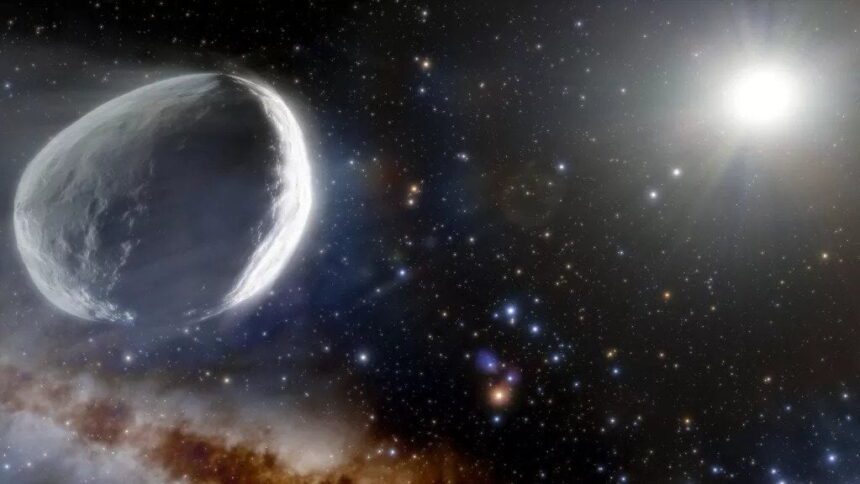
A giant comet found far out in the solar system may be 1,000 times more massive than a typical comet, making it potentially the largest ever found in modern times.The object, officially designated a comet on June 23, is called Comet C/2014 UN271 or Bernardinelli-Bernstein after its discoverers, University of Pennsylvania graduate student Pedro Bernardinelli and astronomer Gary Bernstein.
Astronomers estimate this icy body has a diameter of 62 miles to 124 miles (100 to 200 km), making it about 10 times wider than a typical comet. This estimate is quite rough, however, as the comet remains far away from Earth and its size was calculated based on how much sunlight it reflects. The comet will make its closest approach to our planet in 2031 but will remain at quite a distance even then.
“We have the privilege of having discovered perhaps the largest comet ever seen — or at least larger than any well-studied one — and caught it early enough for people to watch it evolve as it approaches and warms up,” Bernstein said in a June 25 statement from the National Science Foundation’s National Optical-Infrared Astronomy Research Laboratory, or NOIRLab.
First spotted in archival images from the Dark Energy Survey taken in 2014, Comet Bernardinelli-Bernstein is now located at the equivalent distance of Uranus, roughly 20 astronomical units (AU) from the sun. (One AU is the Earth-sun distance — about 93 million miles, or 150 million kilometers). The comet shines at magnitude 20, making it out of reach of most amateur astronomers’ telescopes; by comparison, most people can see objects of magnitude 5 or 6 with the naked eye in dark conditions.
When the comet swings closer to Earth in 2031, it will still be at 11 AU, which is a little more distant than Saturn’s average orbit from the sun. Even then, amateur skywatchers will still need to use very large telescopes to see it, NSF stated.What makes Comet Bernardinelli-Bernstein so special, aside from its size, is the fact it hasn’t visited the inner solar system in three million years, roughly the same era that the famous human ancestor “Lucy” was walking the Earth. The comet originated some 40,000 AU away from the sun in the Oort Cloud, which is a huge, distant region of space thought to hold trillions of comets.

The comet popped up during a scan of archival images of the Dark Energy Survey, which uses a wide-field 570-megapixel CCD imager mounted on the Víctor M. Blanco 4-meter telescope at Cerro Tololo Inter-American Observatory in Chile. The survey’s main goal is mapping 300 million galaxies across a swath of the night sky, but its deep-sky observations have also yielded several comets and trans-Neptunian objects (TNOs), which are icy worlds orbiting beyond Neptune.
Bernardinelli and Bernstein spotted the comet using the National Center for Supercomputing Applications and Fermilab, identifying 800 TNOs from archival survey data. While the images of the comet didn’t show a classic tail between 2014 and 2018, an independent observation from the Las Cumbres Observatory network in 2021 (after the comet’s existence was made public) showed the comet now has a coma of gas and dust surrounding it.

Studying the comet will not only give us more insight into how this massive object formed and evolves, but it also could shed light on the early history of giant planet movements in the solar system, NSF officials noted in the same press release.
“Astronomers suspect that there may be many more undiscovered comets of this size waiting in the Oort Cloud far beyond Pluto and the Kuiper Belt,” NSF stated. “These giant comets are thought to have been scattered to the far reaches of the solar system by the migration of Jupiter, Saturn, Uranus and Neptune early in their history.”
While planned cometary observation campaigns are in their early stages, a typical big event usually gets attention from the largest telescopes in space and around the world. By 2031, several newer observatories may be online to look at Comet Bernardinelli-Bernstein.
Upcoming major ground-based observatories include the NSF’s and Department of Energy’s Vera C. Rubin Observatory, whose first light is expected in 2022; the European Southern Observatory’s Extremely Large Telescope, whose first light is expected by 2025; and the Giant Magellan Telescope which should be and running by the late 2020s.
It’s harder to predict if any spacecraft will be able to observe the comet’s approach, because space missions tend to be shorter than the lifespans of ground-based scopes. It’s possible, however, that a future telescope or mission could be funded by 2031 for comet observations that is not yet approved or even planned. The major space agencies may also task existing spacecraft across the solar system to look at Comet Bernardinelli-Bernstein, as happened near Mars in 2014 when Comet Siding-Spring zoomed past the Red Planet.
NASA’s James Webb Space Telescope is scheduled to launch in late 2021 for a prime mission of at least 5 1/2 years, although Webb could run for a decade or more if it remains healthy and funding is maintained, NASA says. The Hubble Space Telescope (currently facing a problematic computer glitch) is famous for comet observations and may be available in 2031, although predictions say it could be healthy through the mid-2020s and will be deorbited no later than the 2030s.
Checkout more such content at: https://gogomagazine.in/category/tech/





4
5