

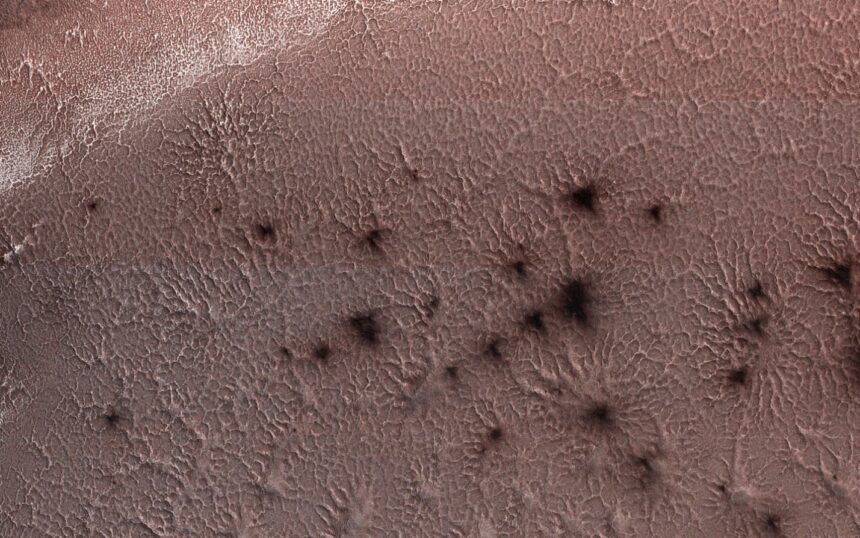
Another investigation has clarified the secret behind ‘insects from Mars.’ These creepy crawlies, which show up as dull masses encompassed by worm-like aggravations, has consistently been a secret to the researchers they are not found on Earth. Specialists from Trinity College in Dublin clarified in another investigation, distributed in the diary Scientific Reports, that the arachnids alluded to as transforms ‘accepted to be cut into the Martian surface by dry ice changing straightforwardly from strong to gas in spring.’
The examination gives the main actual proof supporting that these insects are a side-effect of moving periods of Mars and shaped by the sublimation of CO2 ice. The Mars air contains generally CO2, and as temperature drops in winter, the gas stores on a superficial level as ice and ice. As the temperature rises, it straightforwardly abandons strong to gas through an interaction known as sublimation.
These splodges are ‘odd looking negative geology outspread frameworks of dendritic box; designs that take after parts of a tree or fork lightning.’
The group of researchers from Trinity College, Durham University and the Open University did a progression of examinations reproducing the conditions on the red planet to explore if comparable examples would be shaped by dry ice sublimation.
‘Mars reproduction chamber’ was made utilizing CO2 ice squares and penetrating openings in them. These were drifted over granular beds of various grain sizes prior to bringing down the pressing factor in the chamber to Martian air pressure and the ice blocks were put on a superficial level, as per the public statement.
It expresses that a bug design was disintegrated by getting away from each situation. The bug designs were more extended when better grain sizes were utilized, while the example was less fanned when coarser grains were utilized. The Leidenfrost impact was utilized to lead the analysis.
Dr Lauren McKeown, who drove the investigation, states it presents the previously set of exact proof “for a surface cycle that is thought to alter the polar scene on Mars.” She adds the trials show that these Spider examples can be “cut by the immediate change of dry ice from strong to gas.
Checkout more such content at: https://gogomagazine.in/category/tech/





4.5