

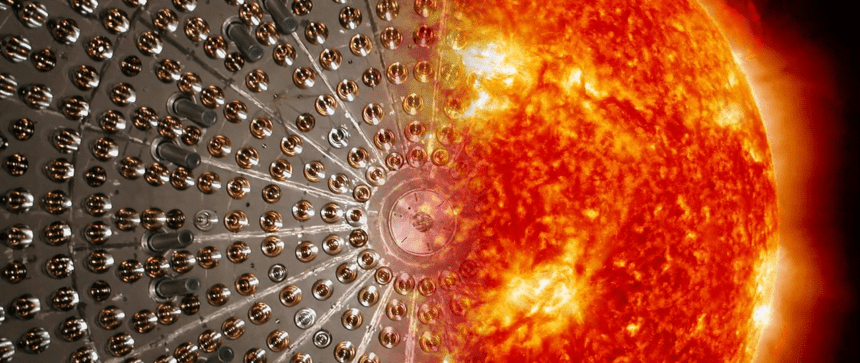
The detection of these neutrinos shows that while the Sun is primarily powered by proton fusion, bigger & hotter stars are powered by ‘CNO cycle’ fusion.
Astronomers at the Borexino particle detector in Italy have announced the detection of neutrinos in the Sun during its secondary fusion process, also called the CNO cycle. This is one of two ways in which the Sun converts hydrogen to helium, but it is not considered to be the dominant mechanism of fusion in the Sun.
Neutrinos — a group of fundamental particles with no charge, a very small mass, but lots of energy — have previously been observed in the Sun during the primary fusion process, which is commonly called the proton-proton (p-p) chain reaction. However, they have been detected through the secondary process for the first time. It offers further insights into fusion reactions in stars more massive than the Sun, which use the CNO cycle is the dominant mechanism of burning.
The findings were published by the Borexino collaboration team in the journal Nature Wednesday.
The Borexino scientific collaboration is an experiment at the Gran Sasso National Laboratories of the Italian National Institute for Nuclear Physics (INFN), the largest underground laboratory in the world, which studies neutrinos and other aspects of astroparticle physics.
How fusion happens in the Sun
The p-p chain reaction occurs in stars with mass less than or equal to 1.3 times that of the Sun. Stellar nucleosynthesis, the process by which elements are created inside stars, takes place by simply combining first the two hydrogen atoms, which form deuterium, an isotope of hydrogen, before eventually settling into a stable form of helium called Helium-4.
The p-p chain involves only hydrogen and helium; but at higher temperatures, the next three elements in the periodic table — lithium, beryllium and boron — also get in the mix.
The other mechanism of fusion is the carbon-nitrogen-oxygen (CNO) cycle, which involves the next three elements. These elements and hydrogen react with each other, eventually resulting in the same stable Helium-4.
At lower temperatures, p-p chain reactions dominate, but at high temperatures, such as those found in more massive stars with hotter cores, which exceed temperatures of 20 million degrees Celsius, the CNO cycle is the primary fusion process. The Sun has a core temperature of about 15 million degrees Celsius.
The mass of the star determines how hot the temperature near its centre is, and in turn, this temperature favours either the p-p chain or the CNO cycle, it was hypothesised that the temperature at the core of the Sun was barely enough to sustain the CNO cycle, and the dominant pathway for producing energy in the Sun is the p-p chain. This result confirms that, but at the same time, for the first time, this work provides an exact estimate of how small the contribution of the CNO cycle is to the overall energy output of the Sun,”
The Borexino detector

The Borexino detector is specifically built for observing neutrinos by drowning out other forms of radiation and noise. Its primary objective is to study neutrinos from the Sun and compare them to theoretical models and projections.
“Despite the exceptional successes previously achieved and an already ultra-pure detector, we had to work hard to further improve the suppression and understanding of the very low residual backgrounds, so that we could identify the neutrinos of the CNO cycle,” said Gioacchino Ranucci, researcher at INFN and a spokesperson of Borexino, in the same statement cited above.
The detector is also a part of the Supernova Early Warning System (SNEWS), a network of neutrino detectors designed to point to supernovae within the galaxy or near it.
“This is the culmination of a 30-year-long effort that began in 1990, and of more than 10 years of Borexino’s discoveries in the physics of the Sun, neutrinos and finally stars,
Identifying CNO neutrinos
Fusion reactions in the sun produce huge quantities of neutrinos — which are some of the most abundant particles in the universe. They can pass through matter, and trillions of these particles do exactly that around us every second.
Neutrinos produced by the p-p cycle are plenty, but those from the CNO cycle are very hard to observe as their signal is extremely faint.
However, thanks to the Borexino particle detector, these faint neutrinos were able to be isolated in the observations, thanks to a different spectral signature due to different energy levels.
By carefully accounting for the difference in the distribution of energies, the scientists involved in this study could segregate neutrinos produced by the CNO cycle.
Checkout more such content at: https://gogomagazine.in/category/tech/





4
4.5