By using this site, you agree to the Privacy Policy and Terms of Use. We improve our products and advertising by using Microsoft Clarity to see how you use our website. By using our site, you agree that we and Microsoft can collect and use this data. Our privacy statement has more details Privacy Policy
Accept
GOGO MagazineGOGO Magazine
  • Home
  • Categories
    • Art
    • BlogNew
    • Featuring
    • Health
      • Food
    • Lifestyle
    • Music
    • Photography
    • Politics
    • Reviews
      • Cafe Reviews
    • Social
    • Sports
    • Tech
    • Travel
    • Travel Stories
  • My Bookmarks
  • Post Submission
  • My Account
Search
  • Customize Interests
  • Cart
  • Checkout
Reading: SPACE, ASTRONOMY, AND STARLINK
Share
0

No products in the cart.

Notification Show More
Font ResizerAa
GOGO MagazineGOGO Magazine
0
Font ResizerAa
  • Blog
  • Art
  • Travel
  • Social
  • Lifestyle
  • Tech
Search
  • Home
  • Categories
    • Blog
    • Art
    • Travel
    • Social
    • Lifestyle
    • Tech
    • Music
    • Sports
    • Featuring
    • Photography
    • Politics
    • Health
    • Reviews
    • Travel Stories
  • My Bookmarks
  • Post Submission
  • My Account
Have an existing account? Sign In
Follow US
GOGO Magazine > Blog > Tech > SPACE, ASTRONOMY, AND STARLINK
Tech

SPACE, ASTRONOMY, AND STARLINK

Himadri Chatterjee
Last updated: August 16, 2020 10:27 pm
Himadri Chatterjee Published August 16, 2020
Share
5 Min Read
SHARE

Over the past year, SpaceX has been launching hundreds of small broadband internet-beaming satellites into low-Earth orbit as part of its Starlink constellation. The tally as of August 2020: 597. Ever since SpaceX launched its first batch of internet-beaming satellites last year, astronomers have watched with dreads as the company continued to blast more spacecraft into orbit.

While the promise of reliable and fast satellite internet accessible from pretty much anywhere in the world sounds pretty promising, not everybody is happy. As it turns out, the tiny satellites are way brighter than anybody was expecting and that’s bad news for astronomers. Over the last couple of months, countless reports have emerged of frustrated astronomers having their observations ruined by Starlink satellites appearing as bright streaks of light. From the darkest skies you can find on Earth, approximately 9,000 stars are visible to human eyes: down to a visual magnitude of +6.5, the limit of human vision. 

Up until now, people have been somewhat in the dark about the true impact of SpaceX’s internet-from-space project called Starlink, which envisions nearly 12,000 of these satellites orbiting Earth. SpaceX’s satellites are super bright compared to others, and astronomers have been worried that with so many luminous satellites in the sky, the odds of one passing in front of a telescope and obscuring an image will increase.

It turns out, some astronomers have reason to be concerned. Certain types of astronomy may be more negatively affected than others, one peer-reviewed study shows, particularly those kinds that scour large swaths of the sky over long periods of time looking for faint, faraway objects. That means scientists looking for distant objects beyond Neptune — including the hunt for the mysterious Planet Nine — might have trouble when Starlink is complete. 
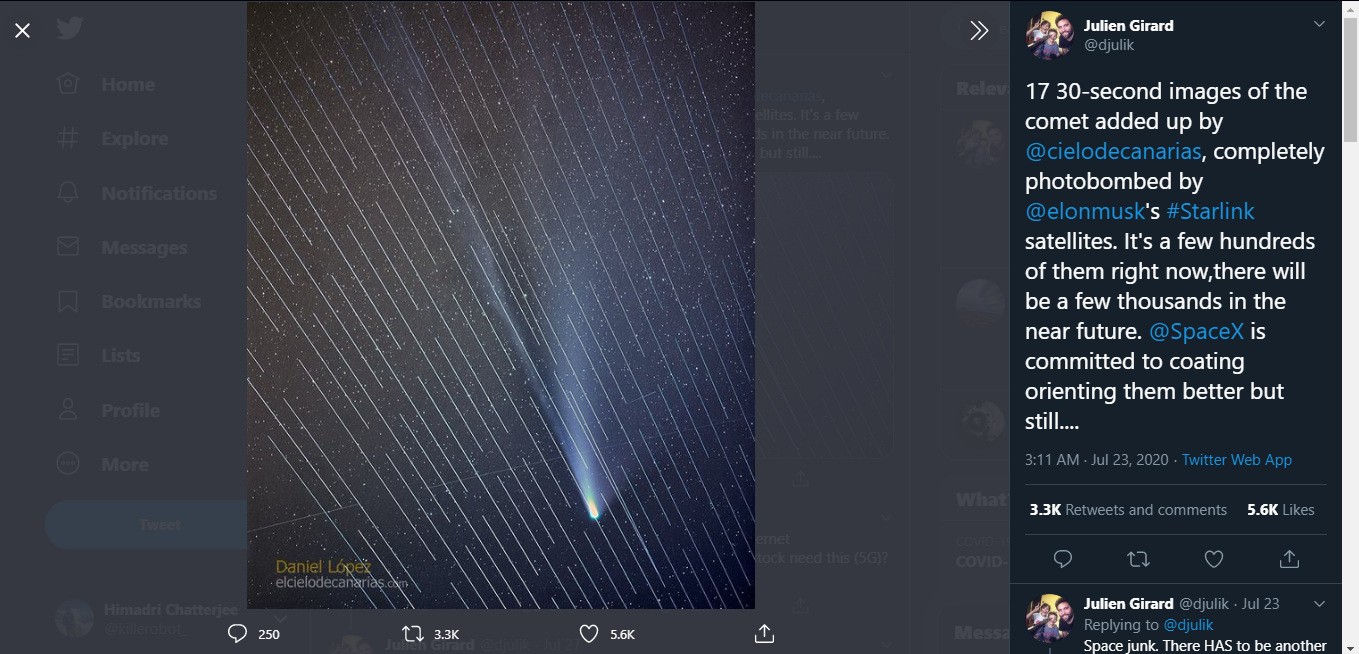
They’re so bright, in fact, that some are visible to the naked eye. In fact, onlookers keep mistaking them for UFOs, according to news reports from December.The brightness is due in part to the fact that the Starlink satellites are orbiting Earth at much closer distance than most — an operational altitude of roughly 550 kilometers, rather than the usual medium-Earth orbit (at 20,000 km) or geostationary orbit (at 36,000 km) used by other kinds of satellites.
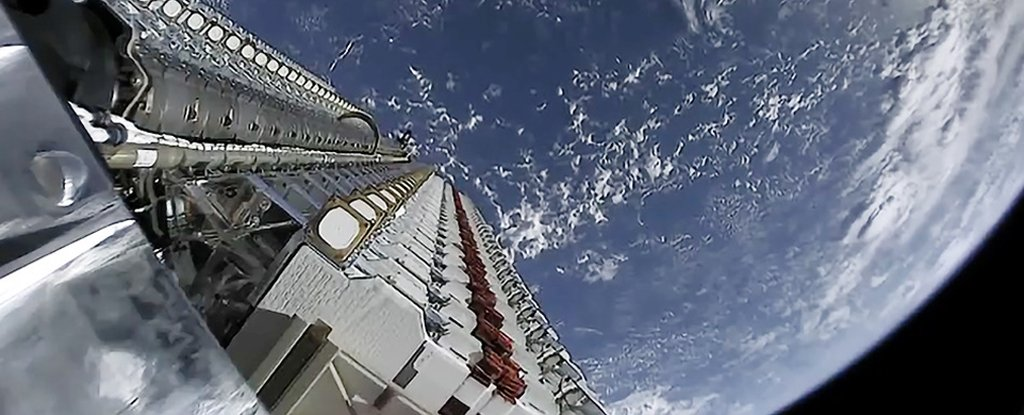
 The sky is a big canvas, and one tiny satellite isn’t going to be a major headache. A host of factors dictate exactly how and when satellites will be a problem. A satellite’s size, shape, height, and path around Earth all affect exactly how much light it reflects from the Sun and where people will see it the most. Meanwhile, the time of year and the time of night determine how much sunlight is shining on a satellite at any given moment.In the more northern and southern latitudes, Starlink satellites will dominate the horizon during the first and last few hours of the night. In the summertime, it’ll be much worse, with hundreds of satellites visible for those in rural areas away from city light pollution.

Luckily, SpaceX claims it’s working on a number of solutions.Early attempts to paint the underside of each satellite with an anti-reflective coat of paint seem to have only been partially successful.

SpaceX is now trying out a new method: launching satellites with a cool pair of sunglasses.  The space company is planning to mount retractable sunshades, called “VisorSat,” to each of the satellites to block sunlight from hitting its reflective parts.

If no solution is found, astronomers could be struggling with bright Starlink satellites ruining their observations for many years to come. SpaceX already has permission from the Federal Communications Commission to launch tens of thousands of Starlink satellites to bring global internet coverage to the world.

Checkout more such content at: https://gogomagazine.in/category/tech/

You Might Also Like

Intel Core i9-11900k outperforms RYZEN

Facebook–Cambridge Analytica data scandal

My top 5 anime recommendations.

XIAOMI MI PAD 5

Report recommends NASA accelerate space nuclear propulsion development

TAGGED:aerospaceastronomiaastronomyastrophotoastrophotographyastrophysicsgalaxiesrocketspacespacecraftspacelinkspacexspacexlandingstarlinkstarship
Share This Article
Facebook X Whatsapp Whatsapp Reddit Email Copy Link Print
Share
By Himadri Chatterjee
Follow:
Just a normal Bengali /Himachali guy| Love astronomy and Literature (typical Bengali)|Space Olympiad winner|Sci-fi lover|
4 Comments 4 Comments
  • Anonymous says:
    August 16, 2020 at 11:59 pm

    5

    Reply
  • Anonymous says:
    August 17, 2020 at 7:48 am

    4.5

    Reply
  • Anonymous says:
    August 17, 2020 at 11:14 am

    1

    Reply
  • Himadri Chatterjee says:
    August 17, 2020 at 3:28 pm

    5

    Reply

Leave a Reply Cancel reply

Your email address will not be published. Required fields are marked *

Stay Connected

1.5kFollowersLike
17.2kFollowersFollow
528SubscribersSubscribe
- Advertisement -
Ad imageAd image

Latest News

Game-Changing Rules That Will Be In Effect for the Upcoming 2025 IPL: Retention, Match Fees, and ICC Code of Conduct
Sports January 29, 2025
Is Sunita Williams stuck in space
Social November 20, 2024
Sakshi Malik Wrestling Protest: The Fight for Justice in Indian Wrestling
Politics October 3, 2024
How To Celebrate Diwali with Younger Children: A Parent’s Guide
Social October 2, 2024
Vineet Dwivedi – “A New Offbeat Indie Artist “
Music June 23, 2024
From Viral Hit to Indie Dreams: Suzonn Gears Up for “Baavre Ho Gaye”
Featuring May 1, 2024

You Might Also Like

Tech

NASA’s Ingenuity Mars Helicopter Succeeds in Historic First Flight

May 2, 2021
Tech

Ryzen 7 5800X and ryzen 9 5900x benchmark and release date announced

October 4, 2020
Tech

The weird space that lies outside our Solar System

September 13, 2020
Tech

NFT Marketplace Cent That Sold Jack Dorsey’s First Tweet Shutters Operation Due to Fakes, Wash-Trading

February 13, 2022

GOGO Magazine – Keep Rollin Happiness!
Featuring talent and businesses from across the 🌎

Quick Link

  • Shop
  • Contact
  • Customize Interests

Top Categories

  • Blog
  • Art
  • Travel

My Account

  • My Account
  • Cart
  • My Bookmarks

DMCA Protection

DMCA.com Protection Status

Site Report

GOGO MagazineGOGO Magazine
Follow US
© 2022 GOGO Magazine. All Rights Reserved.
Join Us!
Subscribe to our newsletter and never miss our latest news, podcasts etc..

Zero spam, Unsubscribe at any time.
Welcome Back!

Sign in to your account

Username or Email Address
Password

Lost your password?

Not a member? Sign Up