

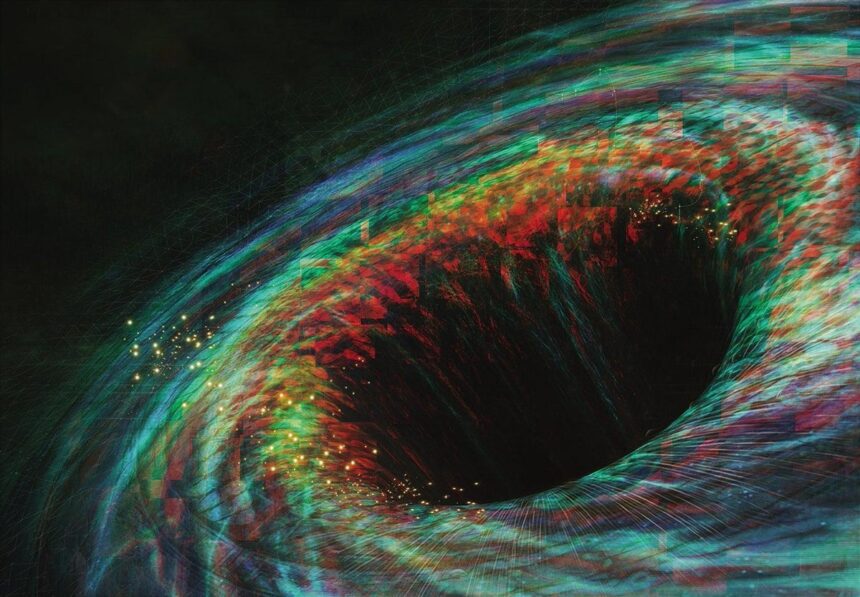
- According to quantum mechanics: data can never be wrecked. In any case, when joined with general relativity, quantum decides to state that dark openings demolish data.
- Scientists have proposed modifications: to the old-style image of dark openings that could unravel the paradox, however, they need proof to test them.
- That is changing with the new Event Horizon Telescope: which as of late took the principal image of a dark opening, just as with gravitational-wave estimations of dark openings impacting.
Mankind got its first look at a dark opening on April 10, 2019. The Event Horizon Telescope (EHT) group, which utilizes an Earth-spreading over the organization of radio observatories acting in show, common pictures it had caught of an obvious dark opening with 6.5 multiple times the mass of our sun in the focal point of the close by M87 world. This was a stunning accomplishment—our first perspectives on one of the most strange articles known to man since quite a while ago anticipated however never legitimately “seen.” Even additionally energizing, the pictures, and the perceptions that ought to follow, are starting to give new insights around perhaps the most profound riddle in material science.
This conundrum is the “Catch 22” of what befalls data in a dark opening. By exploring this inquiry, physicists have found that the simple presence of dark openings is conflicting with the quantum-mechanical laws that so far depict everything else in our universe. Settling this irregularity may require a theoretical upset as significant as the oust of old-style material science by quantum mechanics.
Scholars have investigated numerous thoughts, yet there has been minimal direct proof to help settle this issue. The principal picture of a dark opening, nonetheless, starts to offer genuine information to advise our speculations. Future EHT perceptions—particularly those that can show how dark openings advance after some time—and ongoing location of impacting dark openings by gravitational-wave observatories could give significant new experiences and help to introduce a totally different time of material science.
THE INFORMATION PROBLEM
In spite of the fact that profoundly strange, dark openings appear to be omnipresent in the universe. The EHT perceptions and the gravitational-wave estimations are only the most recent and most powerful proof that dark openings, regardless of sounding fantastical, do undoubtedly have all the earmarks of being genuine—and amazingly normal. However, their very presence undermines the current establishments of material science. The fundamental standards of quantum mechanics are thought to administer the wide range of various laws of nature, yet when they are applied to dark openings they lead to an inconsistency, uncovering an imperfection in the current type of these laws.

The issue emerges from probably the easiest inquiry we can pose about dark openings: What ends up stuffing that falls into them? We need a little refinement here to completely clarify. To begin with, as per our current quantum-mechanical laws, matter and energy can move between various structures: particles can, for instance, change into various types of particles. In any case, the one thing that is sacrosanct and never annihilated is quantum data. On the off chance that we know the total quantum portrayal of a framework, we ought to consistently have the option to precisely decide its prior or later quantum depiction with no loss of data. So a more exact inquiry is, What happens to quantum data that falls into a dark opening?
Our comprehension of dark openings originates from Albert Einstein’s overall hypothesis of relativity, which depicts gravity as emerging from the shape of reality; a typical representation of this thought is a weighty ball disfiguring the outside of a trampoline. This distorting of spacetime makes the directions of huge bodies and light curve, and we call that gravity. On the off chance that mass is adequately moved in a little enough region, the close by spacetime misshapen is solid to such an extent that light itself can’t get away from a district inside what we call the function skyline: we have a dark opening. Furthermore, if nothing can travel quicker than light—including data—everything must stall out inside this limit. Dark openings become grandiose sinkholes catching data alongside light and matter.
Be that as it may, the story gets more interesting. What might be Stephen Hawking’s most prominent disclosure is his 1974 expectation that dark openings vanish. This finding likewise prompted the alarming thought that dark openings annihilate quantum data. As per quantum mechanics, sets of “virtual particles” fly into reality constantly, all over the place. Commonly such a couple, comprising of a molecule and its antimatter partner, rapidly demolishes, yet in the event that it structures close to the skyline of a dark opening, one molecule may spring up inside this limit and the other outside. The external molecule can evade, diverting energy. The law of energy preservation reveals to us that the dark opening has consequently lost energy, so the discharge of such particles makes the dark opening therapist after some time until it totally vanishes. The issue is that the getting away from particles, known as Hawking radiation, convey basically no data about what went into the dark opening. Consequently, Hawking’s computations seem to show that quantum data that falls into a dark opening is eventually demolished—negating quantum mechanics.
This disclosure started a profound emergency in material science. Incredible advances have followed from past such emergencies. For example, toward the start of the twentieth century, old-style material science appeared to foresee the unavoidable precariousness of particles, in clear inconsistency to the presence of stable issue. That issue assumed a key function in the quantum upset. Traditional material science inferred that in light of the fact that circling electrons inside particles are continually altering course, they consistently radiate light, making them lose energy and twisting into the core. However, in 1913 Niels Bohr suggested that electrons really travel just inside quantized circles and can’t twisting in. This extreme thought assisted with setting up the premise of quantum mechanics, which is a general sense revised the laws of nature. Progressively it appears to be that the dark opening emergency will also prompt another change in perspective in material science.
Checkout more such content at: https://gogomagazine.in/category/tech/





4.5