


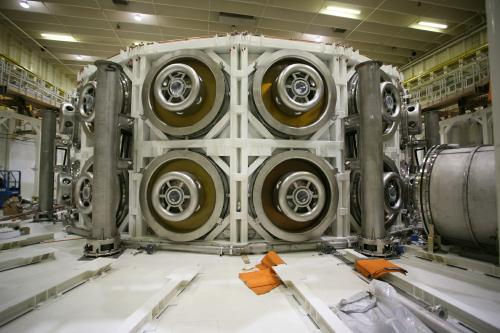
Every time the plasma physicists at Sandia National Laboratories in Albuquerque, New Mexico, fire a shot on their fusion reactor, a big chunk of the hardware goes up in smoke. Their Z machine contains banks of capacitors that fill up with more electrical energy than a thousand lightning bolts. With the flip of a switch, 20 million amps surge toward a fuel-filled cylinder the size of a pencil eraser. The electrical current induces an overwhelming magnetic field, which pinches the tube so fast and furiously that hydrogen atoms inside fuse into helium, releasing a blast of high-energy neutrons and helium nuclei (known as particles). The blast vaporizes the intricate hardware that holds the tiny tube—10 kilograms of solid metal. “We’re basically delivering three sticks of dynamite worth of energy,” says Mike Cuneo, a manager on the project. “After, there’s a crater a foot wide.”
The physicists are now preparing to make even bigger bangs by adding a precious fuel, used in thermonuclear weapons, that carries both risks and rewards. Calculations, simulations, and experimental results published in recent years suggest that Sandia’s machine could offer a quicker and cheaper path to self-sustaining fusion than other approaches that blast the fuel with lasers or trap it in reactors called tokamaks. But so far the Z machine has unleashed its fury mainly on deuterium (hydrogen with one neutron in its nucleus), which releases limited amounts of fusion energy. In August, however, researchers added a dash of tritium—hydrogen with two neutrons. Over the next 5 years, the tests will gradually ramp up to a 50-50 blend of deuterium and tritium (DT).
Fusion of 50-50 DT fuel releases 60 to 90 times as many neutrons as deuterium only fusion does, and each of the neutrons and α particles ejected from DT fusion carries more than four times the energy of their deuterium-only counterparts. As tritium levels in the fuel rise toward 50%, energy yields should soar.
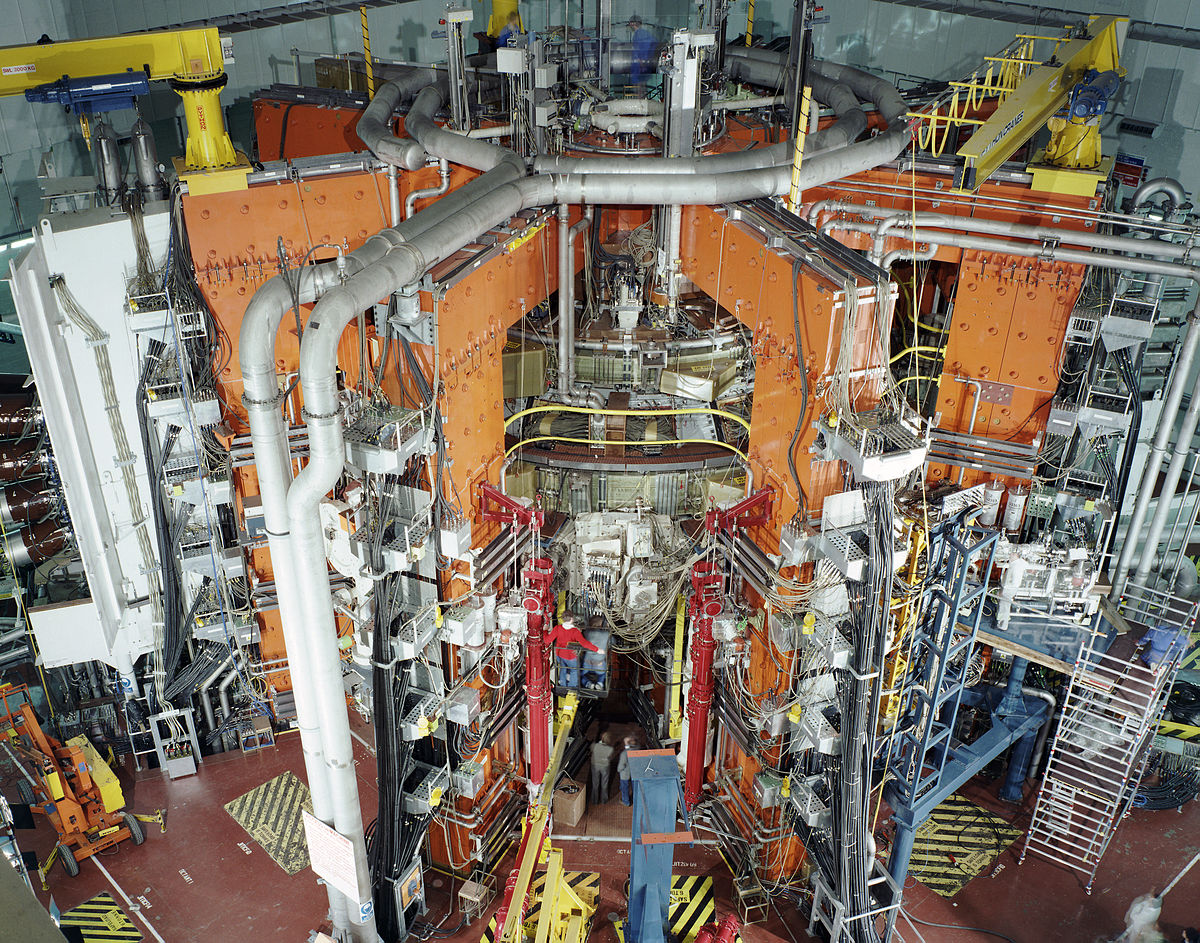
Other fusion efforts have followed the same path. In 1997, the Joint European Torus (JET), a tokamak in Abingdon, U.K., burned 50-50 DT to generate 16 megawatts of power, though for less than a second. That shot set a record for fusion power output that still stands today. But graphite in JET’s reactor walls limited the output. “Carbon is like a sponge for tritium, so about 17% of the tritium we injected stuck to the wall,” recalls Xavier Litaudon, who heads the ITER physics department in Oxford, U.K., and is now lobbying to extend JET’s funding to include a new round of DT experiments in 2019. ITER, the overbudget and overdue international tokamak under construction near Cadarache in France, has staked its mission on eventually using DT to liberate far more power from fusion than is put in.
Unlike a tokamak, which uses magnetic fields to stabilize a wispy ring of hot plasma, the Z machine relies on inertia and a magnetic cage to contain the superheated fuel during microsecond long shots. The approach, called magneto-inertial fusion, shares more in common with fusion efforts like that at the National Ignition Facility (NIF) at Lawrence Livermore National Laboratory in California, where trillion-watt lasers zap pellets of fuel to induce fusion. Sandia and NIF scientists don’t have to worry about losing tritium into graphite because unlike tokamaks, their machines have no containing walls. Moreover, Cuneo says, unlike NIF, the Z machine’s magnetic field can slow emerging α particles and trap them along field lines, funnelling more energy into sustaining the fusion.
Sandia is one of only three fusion centers currently using DT (see table, below). One issue is cost. Tritium costs tens of thousands of dollars a gram because there is no natural repository of the stuff; it is produced in nuclear reactors as a byproduct of fission.
Adding fuel to the fire
Sandia’s Z machine joins a small club of fusion reactors that have used deuterium-tritium (DT) fuel.
| Reactor | Location | DT fuel used | Note |
| Tokamak Fusion Test Reactor | Princeton, New Jersey | 1993-1997 | Decommissioned |
| OMEGA | Rochester, New York | 1995-present | DT systems stretch back to 1979 |
| Joint European Torus | Abingdon, U.K. | 1991-1997 | New DT campaign planned for 2019 |
| National Ignition Facility | Livermore, California | 2010-present | Failed to achieve ignition with DT |
| ITER | Cadarache, France | 2035 (planned) | DT use delayed from 2021 to 2035 |
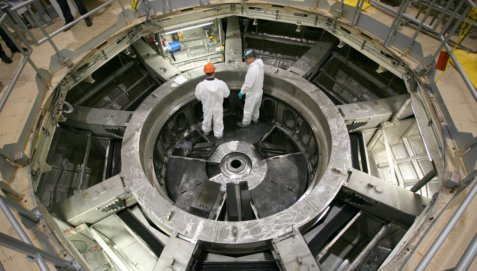
Another issue is safety. “Tritium is mildly radioactive—it has a 12-year half-life—so regulations require you to handle it very carefully,” says Rich Hawryluk, a researcher at the Princeton Plasma Physics Laboratory (PPPL) in New Jersey. What’s more, the neutrons from DT fusion bang into steel parts and make them slightly radioactive. So when PPPL closed a reactor after its DT runs in the 1990s, the room-sized vessel was filled with concrete, sliced up, and buried at the Hanford nuclear reservation in Washington state.
In the presence of water, including humidity in the air, tritium can form tritiated water, which is at least ten thousand times more biologically hazardous than pure T2 gas, Hawryluk says. That is a special concern at the Z machine, which insulates electrical components in pools of oil and water. “We do not want tritium to get into those,” Cuneo says.
At NIF, tritium presents fewer hazards because it is contained within a tiny sphere during transport, and workers don’t often enter the interior of the machine. Sandia’s capsule, in contrast, is open at both ends, and the violent implosion mixes unburned tritium with vaporized metal that sprays everywhere. “People have to go in and completely replace the centre of the accelerator after every shot,” Cuneo says.
Sandia is nevertheless moving forward with tritium, in part because it generates extra neutrons that reveal what’s happening in the hottest, densest part of the short-lived plasma, where the physics is not as well understood. In three planned shots next year, Cuneo says, they will remove a tritium containment system from around the target both to test an air-purging safety system and to get a clearer view of the neutrons.
Checkout more such content at: https://gogomagazine.in/category/tech/





4